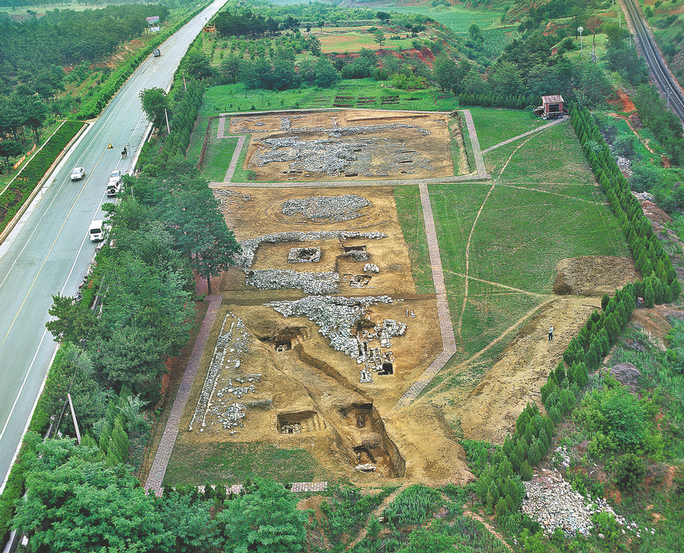
Site of Niuheliang
Overview
The Site of Niuheliang is a significant archaeological site located in Chaoyang city, Liaoning province, in Northeast China. It is closely associated with the Hongshan Culture, a late Neolithic culture that thrived approximately 5,000 to 5,800 years ago. The Niuheliang site is renowned for its rich cultural heritage and its role in shaping ancient Chinese civilization. Discovered in 1983, this site has provided invaluable insights into the religious practices, social structures, and artistic achievements of the Hongshan people. A distinctive feature of the Niuheliang site is its complex of ritual monuments, including a goddess temple, a three-tiered circular altar, and rubble mound tombs. These structures reflect a sophisticated understanding of ritualistic practices and social hierarchy during the late Hongshan period.
The discovery of a life-size clay head sculpture of a goddess at Niuheliang was a groundbreaking find that challenged existing notions about the origins of Chinese civilization. The sculpture, with its intricate details and use of jade for the eyes, suggested a high level of artistic skill and religious significance. The goddess temple, partially built underground, contains murals and clay structures that resemble traditional Chinese timber-framed designs, highlighting the advanced architectural techniques of the time. The Niuheliang site serves as a testament to the advanced social organization and spiritual beliefs of the Hongshan Culture, which played a crucial role in the formation of early Chinese civilization.
Niuheliang is not only an important archaeological site but also a key component of China's cultural heritage. It is part of a broader network of Hongshan Culture sites that span across modern-day Inner Mongolia, Liaoning, and Hebei provinces. These sites, characterized by their jade artifacts and ritualistic structures, illustrate the cultural diversity and complexity of early Chinese societies. The Hongshan Culture, with its emphasis on jade rituals, dragon motifs, and ancestor worship, laid the foundation for many aspects of traditional Chinese culture that continue to be revered today.
Archaeological Significance
The archaeological significance of the Niuheliang site lies in its ability to provide a window into the lives, beliefs, and social structures of the Hongshan people. The site is considered a pivotal point in the study of Hongshan Culture due to its extensive ritual complexes and the quality of artifacts unearthed there. The goddess temple, the circular altar, and the associated tombs are indicative of a society that placed a strong emphasis on religious and ceremonial practices. These structures reveal a hierarchical society that utilized rituals to maintain social order and express spiritual beliefs.
The architectural layout of the Niuheliang site demonstrates an advanced understanding of construction and design. The symmetrical arrangement of the ritual monuments, with a central axis leading from the goddess temple to the altar and tombs, reflects a sophisticated planning process. The use of jade artifacts in the tombs, particularly the "pig dragons" and other animal motifs, highlights the symbolic importance of jade in Hongshan society. Jade was not only a material of aesthetic value but also a medium for spiritual expression, signifying power and auspice.
Archaeologists have also found evidence of early astronomical observations at Niuheliang. The three-tiered circular altar, believed to be associated with the celebration of heaven, suggests that the Hongshan people were aware of celestial phenomena and incorporated them into their ritual practices. This integration of astronomy with religious ceremonies indicates a deep connection between the Hongshan people's understanding of the natural world and their spiritual beliefs.
Cultural and Aesthetic Values
The Niuheliang site is a treasure trove of cultural and aesthetic values that reflect the artistic and spiritual legacy of the Hongshan Culture. One of the most striking aspects of the site is its jade artifacts, which are considered masterpieces of Neolithic craftsmanship. The "pig dragons," with their chubby, pig-headed shapes and intricate designs, are iconic symbols of Hongshan art. These jade pieces not only showcase the technical skills of the artisans but also embody the spiritual beliefs and social values of the time.
The architectural elegance of the ritual monuments at Niuheliang further underscores the cultural sophistication of the Hongshan people. The goddess temple, with its clay sculptures and murals, is a testament to the advanced artistic and architectural capabilities of the society. The temple's design, partially built underground with features reminiscent of later Chinese architectural styles, demonstrates an understanding of both aesthetic beauty and functional design.
The cultural practices associated with the Niuheliang site reveal a society deeply engaged with ritualistic and symbolic expressions. The use of jade in funerary contexts, the construction of large ceremonial structures, and the emphasis on ancestor worship are indicative of a culture that valued harmony, continuity, and reverence for the spiritual world. These values have left a lasting imprint on Chinese civilization, influencing subsequent cultural and religious developments.
Legacy and Impact
The legacy of the Niuheliang site extends far beyond its immediate archaeological significance. As a key center of Hongshan Culture, Niuheliang has contributed to a deeper understanding of the early development of Chinese civilization. The site's discoveries have challenged traditional narratives that solely emphasized the Central China Plains as the cradle of Chinese culture, highlighting the diverse and interconnected nature of ancient societies across the region.
Niuheliang has also played an influential role in shaping contemporary perceptions of Chinese cultural identity. The motifs and artistic traditions rooted in the Hongshan Culture, particularly the dragon and jade symbols, continue to resonate in Chinese art, mythology, and cultural expressions. These elements are celebrated as foundational aspects of China's cultural heritage, reflecting a continuous thread that links the past to the present.
The impact of the Niuheliang site is also evident in its contribution to the field of archaeology. The interdisciplinary and international collaborations fostered by the study of the site have set a precedent for archaeological research, promoting a more holistic and inclusive approach to uncovering the past. The site's preservation efforts, including the establishment of the Niuheliang National Archaeological Site Park, have made it a focal point for cultural tourism and education, ensuring that its legacy is appreciated by future generations.
Article reference1. Ancient altars to modern museums. chinadaily.com.cn. 20252. Where Chinese dragons first took flight. chinadaily.com.cn. 20253. Going back to the roots. chinadaily.com.cn. 20244. Sri Lankan student explores Hongshan Culture. chinadaily.com.cn. 20235. Out of the mists of time. chinadaily.com.cn. 2023ExpandPhoto Gallery(8 pictures)CategoriesCultural HeritageTagArchaeological DiscoveryRelatedHongshan CultureCatalogue1. Overview2. Archaeological Significance3. Cultural and Aesthetic Values4. Legacy and Impact-
- []








